


Flutes – Page 7


Taking up the flute: which model should you choose?
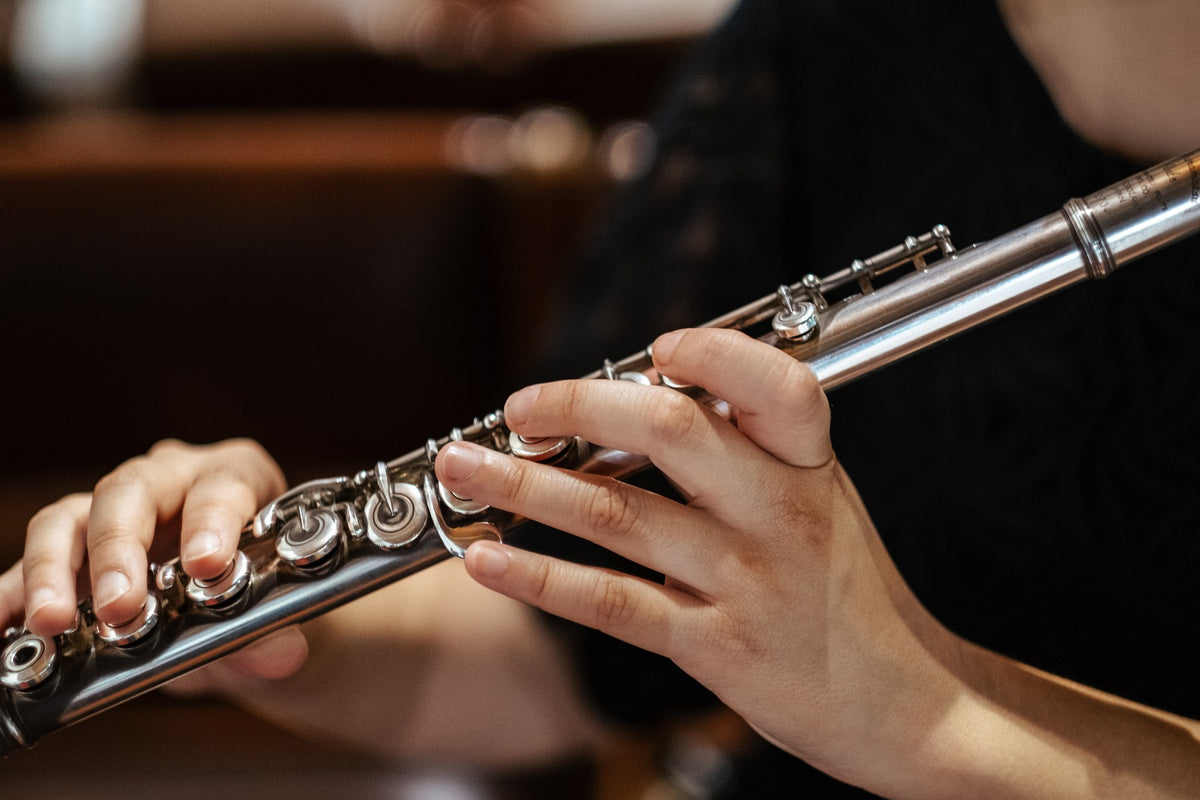
Your first instrument will be a C flute (the standard concert flute). Among the C flutes, a student flute will be more than enough for your first few years. Yamaha is way out in front here, and its student models are known for their reliability. Woodbrass flutes come next. Already got a teacher? Talk to them about the G key before you order; we'll come back to it below.
Closed-hole or open-hole keys? The key cups are the little discs you close with your fingers, and open-hole keys have a hole drilled in the middle. A closed-hole key closes on its own; the note sounds even if your finger is slightly off-centre. With an open-hole key, you need to cover the hole with the pad of your finger, and you soon get the hang of it. There are also small plastic key plugs for open-hole keys, which you remove one at a time as your fingers start landing in the right place. Do closed-hole keys feel more reassuring? No problem, the sound depends mainly on the flute itself. Without plugs, it takes about a month for your hand to settle into position. You'll find a whole range of open-hole flutes (flutes with open-hole keys, in other words). That leaves the key your left ring finger closes to play G (the note).
Usually, it's an in-line G, aligned with the others. On some flutes, it's an offset G, sitting a little outside the row, and your ring finger can reach it without stretching. Children and players with small hands benefit a lot. In France, you almost always learn with an in-line G. German flautists happily choose an offset G, often with a split E mechanism (a part that helps high E speak).
Which flute for a child?
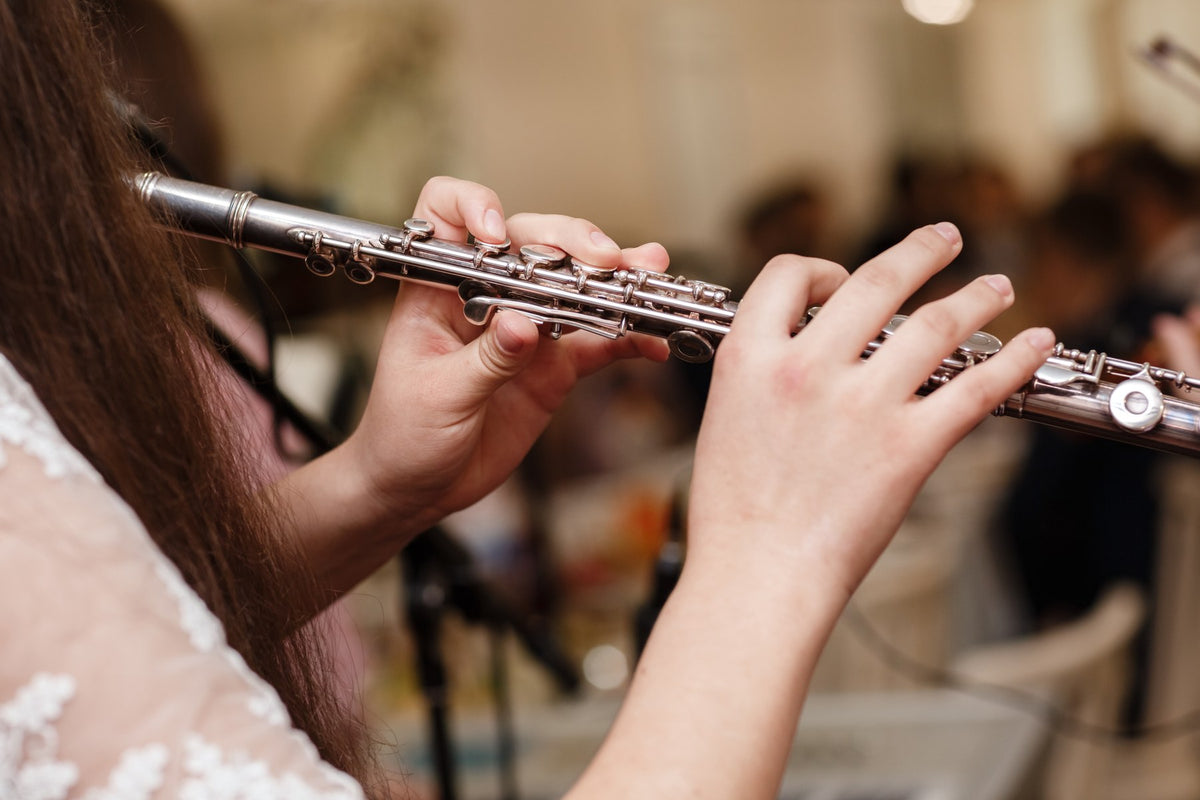
Holding a flute straight at that age is quite a challenge! At arm's length, a full-sized flute is too long for them. That's where a flute with a curved headjoint comes in: the headjoint, the part you blow into, is U-shaped and brings the instrument closer to the face. Their back and shoulders stay straight. You'll find them from Jupiter, SML Paris and Woodbrass, and Yamaha even sells the headjoint separately. Jupiter also has its Waveline, a curvy flute billed as suitable from age five. To help your child reach all the keys without straining, choose closed-hole keys and an offset G too.
For a very young child, Nuvo makes very lightweight composite flutes in coloured plastic. It's a first step before moving on to a metal flute.
Silver headjoint or student flute: when should you upgrade?

A student flute is made from silver-plated nickel silver (a copper-based alloy coated with silver). The next step up is a solid silver headjoint. What difference does it make? The sound becomes rounder, and notes in the high register come with less effort. On your first play-test, the difference isn't always easy to hear. A few weeks later, even the people around you notice it. These are called semi-professional flutes. Yamaha has several, as do Pearl Flute and Azumi, and you'll find them from Trevor James too. Want silver in the body as well? Have a look at some of Powell's Sonare models.
At this level, another option appears on product pages: the B footjoint. The footjoint is the final section, right at the bottom, below your right hand. On a student flute, it goes down to low C (this is called a C footjoint), and that's more than enough to get started. A B footjoint gives you one extra note, the B just below. It can also help in the altissimo register.
Upgrading is something you decide with a flute in your hands. Two silver headjoints from the same brand can respond differently! Try several; the one that responds best to you will be the right one. Among advanced flautists, the Japanese brand Muramatsu has a very good reputation.
Piccolo, alto flute or bass flute: who are they for?

The piccolo sounds an octave above the flute. It's tiny, yet it asks a lot of you! Our advice is to start once you've got a good grounding on the flute. You need to keep your breath pressure up all the time, and on your first few goes, your head starts spinning after fifteen minutes! Don't worry, that passes with practice. Student piccolos have a resin body, while those in the professional range are made of grenadilla, a very dense black wood.
Larger and lower-pitched, the alto flute is pitched in G. It has a warm tone, and it's very popular in flute ensembles. The bass flute is in C and goes an octave below a standard flute. It has a deep tone that sounds superb in a small jazz ensemble, but the attack needs to be clean, or the note jumps to the harmonic above. Alto and bass flutes are heavier to hold up: versions with a curved headjoint are available, and Pearl Flute even supplies some alto flutes with two headjoints, one straight and one curved, so you can choose.
What do you need to go with your flute?
After each session, the inside of the flute is damp. Run a cleaning rod (a rod with a cleaning cloth at the end) through each section. This stops the pads (the cushions under the keys) staying wet: over time, they stick and need replacing. Cleaning rods and cleaning cloths are in the care and maintenance range.
The flute usually comes in its case; this is stated on its product page. For travelling, a case cover slips over it, and the case covers and cases range has options for flutes. During breaks, a flute stand keeps it upright, ready for you to start again.
The first few sessions are often spent on the headjoint alone, without the rest of the flute: you play long tones and work on your sound. You're less likely to get discouraged! A tutor book will then guide you through the fingerings; choose one from the flute tutor books.
Buying your flute from Woodbrass
In Paris, flutes have their own section at the Woodbrass Store Vents & Partitions. The address? 172 avenue Jean Jaurès (Paris, 19th arrondissement), very close to the Paris Conservatoire and the Porte de Pantin. Got your eye on two flutes? Try them in store, one after the other, with your eyes closed if you like, to judge by sound alone. Every flute that's tried out then goes through the shop's hygiene protocol. The Store is open Tuesday to Saturday (10.30 am to 7 pm), and you can park at Vinci Park Cité de la Musique, just a few steps away. Buying your flute in store? You'll be refunded for your first sixty minutes at Vinci Park, so keep your ticket. The wind instrument workshop is on site to service or restore your flute.
Outside Paris, call +33 2 57 88 00 74: the line is open from 9 am to 6 pm Monday to Friday, and from 10 am to 6 pm on Saturday (Paris time). Not sure about the key cups, or a curved headjoint for your child? We get these questions every day, on the phone, by email and on chat. And a flute that disappoints you can be returned: just request it within 30 days of receiving it.
Does your flute develop a fault while it's under warranty? Go to your Woodbrass account, open the order for your flute and describe the problem to after-sales service, with photos or a video to back it up (a squeaking note is easier to hear than to explain). You can then track your case online. Once the flute has been examined, it will be repaired or replaced. In some cases, you'll be refunded. If the brand covers your flute for longer, its product page will tell you.
A student flute is sometimes sold as B-Stock. It has been checked by our teams and comes with a 6-month warranty. Payment in instalments is available with Alma.